
Can ChexSystems Be Removed Before 5 Years?
Blog post description.
3/6/20264 min read
Can ChexSystems Be Removed Before 5 Years?
A Complete, Practical U.S. Guide to Early Removal, Disputes, Negotiation, and Strategic Deletion
If you’ve reviewed your consumer file and discovered a negative entry, you’ve probably seen the standard statement:
“This information may remain on file for up to five years.”
Which leads to the most important question:
Can ChexSystems be removed before 5 years?
Short answer:
Yes — sometimes.
Long answer:
It depends on why the record exists, who reported it, whether it is accurate, and how strategically you handle it.
This guide explains:
When early removal is legally possible
When it is unlikely
The difference between deletion and paid status
How disputes work
When negotiation can trigger removal
What actually works in real-world cases
What wastes time
No vague promises.
No “magic letters.”
Just structured, U.S.-based banking reality.
First: What Is the 5-Year Rule?
ChexSystems generally keeps negative deposit account information on file for up to five years from the date of reporting.
This includes:
Unpaid overdrafts
Account abuse
Fraud designations
Returned item patterns
Charge-offs
The 5-year period is a maximum reporting window — not a mandatory waiting period.
That distinction matters.
When ChexSystems Can Be Removed Before 5 Years
There are four main pathways to early removal:
Inaccuracy (Dispute-Based Removal)
Unverifiable Information
Bank-Requested Deletion (Goodwill or Settlement)
Identity Theft Removal
Let’s break these down clearly.
1. Removal Due to Inaccurate Reporting
If the entry contains incorrect information, it must be corrected or deleted.
Examples:
Wrong balance amount
Incorrect dates
Account not yours
Mixed file error
Identity mismatch
Fraud victim misclassified as fraud suspect
Under federal consumer reporting law, inaccurate data cannot remain.
If the reporting bank cannot verify the accuracy during investigation, ChexSystems must remove it.
This is the most legally solid path to early deletion.
2. Removal Due to Lack of Verification
When you dispute an entry, ChexSystems contacts the reporting bank to verify.
If the bank:
Fails to respond
Cannot produce documentation
Cannot confirm accuracy
The entry must be deleted.
This happens more often with older accounts.
Time increases the chance of unverifiability.
3. Removal Through Negotiation (Pay-for-Delete)
Many consumers ask:
“If I pay the balance, will it be removed?”
Not automatically.
Payment alone usually results in:
“Paid in Full”
“Settled”
However, in some cases, banks will agree to:
Remove the entry entirely
Retract reporting after settlement
This requires negotiation directly with the bank — not ChexSystems.
Smaller regional banks and credit unions are sometimes more flexible.
Large national banks are often stricter.
Written confirmation is critical before payment.
4. Removal After Identity Theft
If the account resulted from identity theft:
File police report
File identity theft affidavit
Dispute formally
If proven, fraud-based entries must be removed.
Victim documentation significantly strengthens early removal cases.
When Early Removal Is Unlikely
Early removal is difficult when:
The debt is accurate
Fraud designation is confirmed
The bank has strict no-delete policy
Documentation fully supports reporting
In these cases, waiting out the five-year period may be the only path — unless negotiation succeeds.
The Difference Between “Removed” and “Updated”
This is where many consumers misunderstand.
Removed means:
Entry disappears entirely.
Updated to Paid means:
Entry remains.
Status changes.
Some banks still deny applications even if paid.
Deletion has stronger approval impact.
How the Dispute Process Works
Step 1: Request your full consumer disclosure from ChexSystems.
Step 2: Identify inaccuracies clearly.
Step 3: Send written dispute via certified mail.
Include:
ID copy
SSN (last 4 digits in body)
Supporting documentation
Clear explanation
ChexSystems typically has up to 30 days to investigate.
If unverifiable → deletion.
If verified → remains.
Why Many Disputes Fail
Common mistakes:
Vague dispute letters
Emotional arguments
No documentation
Online-only disputes
Not specifying exact inaccuracy
Precision wins.
Structure wins.
Emotion does not.
Can You Force Early Removal Just Because It’s Paid?
No.
There is no automatic “paid equals deleted” rule.
However:
Some banks will remove upon settlement if negotiated properly.
Timing matters.
Older accounts often have higher deletion probability during negotiation.
Does Filing a Complaint Help?
If reporting is inaccurate and disputes fail, you may file a complaint with:
Consumer Financial Protection Bureau
Regulatory complaints sometimes prompt deeper review.
But they do not guarantee deletion.
Use this strategically — not emotionally.
How Long Does Early Removal Take?
Typical timeline:
7–10 days to receive report
30 days for investigation
7 days for updated report
If successful, deletion may occur within 30–45 days.
Negotiated deletions vary depending on bank response.
Strategic Order of Operations
If your report includes:
Identity errors
Fraud flags
Unpaid balances
Correct in this order:
Identity accuracy
Fraud status
Balance negotiation
Dispute inaccuracies
Apply for new account
Sequence dramatically affects approval success.
What Happens After Deletion?
Once removed:
Banks pulling ChexSystems will no longer see that entry
Approval odds increase
Some internal bank blacklists may still exist
Deletion improves your profile — but does not erase internal records at the original bank.
When Waiting Makes Sense
If:
Entry is accurate
Bank refuses deletion
Less than 12 months remain
Waiting may be practical.
But if 3–4 years remain, strategic removal attempt is often worth pursuing.
The Financial Cost of Waiting 5 Years
Without stable banking access, you may pay:
Check-cashing fees
Prepaid card fees
ATM surcharges
Money order costs
Over five years, this often exceeds the original balance.
That’s why early removal matters.
Real-World Scenarios
Scenario 1: Inaccurate Balance
Consumer disputed incorrect amount.
Bank failed to verify.
Deleted in 30 days.
Scenario 2: Settlement Negotiation
Consumer owed $620.
Negotiated $350.
Bank agreed to delete upon payment.
Removed within 45 days.
Scenario 3: Confirmed Fraud
Fraud notation verified.
No deletion granted.
Aged off after 5 years.
Each case is different.
The Biggest Myth About ChexSystems Removal
Myth:
“There’s a magic letter that forces deletion.”
Reality:
Removal depends on:
Accuracy
Verification
Bank cooperation
Documentation
Strategy
There is no shortcut without legal basis.
How to Improve Your Odds of Early Removal
Be precise
Provide documentation
Dispute specific inaccuracies
Negotiate professionally
Avoid multiple simultaneous disputes
Maintain paper trail
Professional tone matters.
If Removal Fails — What Next?
Options:
Second-chance checking
Credit union manual review
Wait and reapply later
Continue negotiation after aging
Five years is maximum — not mandatory.
But strategy determines speed.
Don’t Let the “5-Year Rule” Intimidate You
Yes, entries may remain up to five years.
But many consumers successfully:
Dispute inaccurate records
Remove unverifiable entries
Negotiate deletion
Resolve identity theft reports
The difference between waiting five years and resolving within 60 days is knowledge and execution.
Want the Exact Templates and Removal Framework?
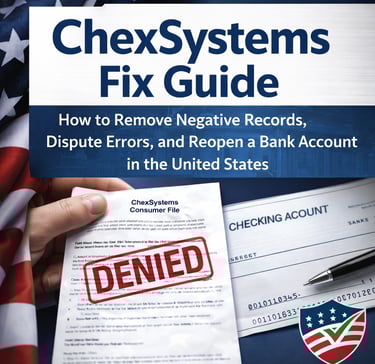
The ChexSystems Fix Guide includes:
Early removal dispute templates
Pay-for-delete negotiation scripts
Fraud flag clarification letters
Identity theft documentation framework
Regulatory escalation structure
Reapplication timing blueprint
Instead of guessing — and risking repeated denials —
You can follow a structured system designed specifically for U.S. consumers dealing with ChexSystems.
Every month without full banking access costs money.
If you want removal before five years — approach it strategically.
Every month you wait is costing you real money in fees, missed bonuses, and denied opportunities.
Stop guessing and stop getting rejected — fix it the right way.
👉 Get the ChexSystems Fix Master Guide now and take back control.
Help
Guidance for fixing your chexsystems report.
Contact
infoebookusa@aol.com
© 2026. All rights reserved.