
Can Joint Account Holders Both Be Reported to ChexSystems?
Blog post description.
3/17/20265 min read
Can Joint Account Holders Both Be Reported to ChexSystems?
What Every Co-Owner Must Understand Before It Damages Both Financial Futures
If you share a bank account with a spouse, partner, parent, sibling, or business partner, here’s a critical question:
If something goes wrong, can both joint account holders be reported to ChexSystems?
The short answer is:
Yes. Absolutely. And it happens more often than people realize.
But the real issue isn’t just whether both names can be reported.
It’s:
When both will be reported
When only one might be reported
How banks decide
How liability works
How to fix the damage
How to protect yourself before it happens
This is not theoretical. Joint account reporting is one of the most common causes of unexpected ChexSystems denials — especially in divorces, breakups, family disputes, and failed business partnerships.
Let’s break it down clearly and practically.
The Core Rule: Joint Accounts = Joint Responsibility
When you open a joint bank account, you typically agree to something called:
“Joint and several liability.”
This means:
Each account holder is 100% responsible
Not 50%
Not proportional
Not “who spent what”
If the account goes negative $2,000:
Both parties legally owe $2,000.
From the bank’s perspective, it does not matter who caused the overdraft.
That’s the foundation of ChexSystems reporting.
What Triggers ChexSystems Reporting on Joint Accounts?
Banks typically report to ChexSystems when:
The account is charged off due to unpaid overdraft
The account is closed for cause
There is suspected account abuse
There are excessive returned items
There are fraudulent transactions tied to the account
There is identity misuse
If two names are on the account, the bank may report both.
Real-World Scenario #1: Spouse Overdraft
Husband and wife share checking account
Wife writes checks
Account goes negative $1,400
Bank closes account
Balance unpaid
ChexSystems report shows:
Husband — reported
Wife — reported
Even if husband never touched the account.
Real-World Scenario #2: Roommate Dispute
Two roommates share an account for rent and utilities.
One roommate:
Withdraws funds
Leaves account negative
Moves out
The other roommate:
Didn’t authorize the transaction
Never used the overdraft
But both are listed as joint holders.
Bank reports both.
Real-World Scenario #3: Parent and Child Account
Parent opens joint account with college student.
Student mismanages funds.
Account closes with unpaid overdraft.
Both parent and student may be reported.
Does the Bank Always Report Both Names?
Not always.
But often.
It depends on:
Bank internal policy
How the account agreement is structured
Whether both were active signers
Whether the bank coded one as primary
Whether the bank attributes fraud to one party
However:
In most unpaid overdraft situations, both names are reported.
What About Authorized Users?
Important distinction:
An authorized user is NOT a joint owner.
Authorized users:
Can use the account
Are not legally responsible
Usually are not reported
Joint owners:
Share ownership
Share liability
Can both be reported
Always confirm which category applies to you.
What Happens on the ChexSystems Report?
If reported, the record may show:
Financial institution name
Amount owed
Reason for closure
“Closed for cause” notation
Date reported
Status (paid/unpaid)
Both individuals can receive separate entries in their consumer files.
That means:
You can be denied banking even if you never wrote a single check.
Can One Joint Holder Remove Themselves Before Damage Happens?
Yes — but timing matters.
If you anticipate conflict:
Close the joint account early
Convert to individual accounts
Get written confirmation of removal
Monitor the account until closure
Once the account is charged off, removal is much harder.
What If You Remove Yourself But The Account Later Goes Negative?
If you properly removed yourself and the bank:
Updated records
Changed ownership status
Confirmed removal
Then you generally should not be reported.
However, documentation is critical.
Without proof, disputes become difficult.
Divorce and ChexSystems
Divorce decrees often say:
“Spouse A is responsible for this account.”
But banks are not bound by divorce agreements.
If the account was joint:
The bank can still pursue both parties.
ChexSystems can still report both.
Divorce orders govern between spouses — not between you and the bank.
What If Only One Person Committed Fraud?
Fraud complicates things.
If:
One joint holder commits fraud
The bank investigates
Evidence points to one party
The bank may report only that person.
But sometimes both are flagged during investigation.
Fraud markers are extremely serious.
Can Both Be Sued?
Yes.
Because liability is joint and several.
The bank can:
Sue either party
Send debt to collections
Report to ChexSystems
It chooses based on recoverability.
How This Impacts Future Banking
If both are reported:
Both can be denied new accounts
Both can be denied business accounts
Both can be denied second-chance accounts
Both may struggle with merchant processing
Even if one was innocent.
What If You Were Unaware of the Activity?
Unawareness does not eliminate liability.
However:
You may dispute if:
Signature was forged
Identity theft occurred
You were improperly added
You were never legally a joint owner
But simply saying “I didn’t use it” is usually insufficient.
How to Protect Yourself Before Opening a Joint Account
Ask yourself:
Do I fully trust this person financially?
Are we financially aligned?
Are spending limits clear?
Do we both monitor statements?
Is overdraft protection active?
Joint accounts require financial compatibility.
How to Monitor a Joint Account Safely
Best practices:
Enable alerts
Check daily balances
Turn off overdraft if possible
Maintain written agreements
Close immediately if trust breaks
The earlier you act, the easier prevention becomes.
What If The Balance Is Paid Later?
If one party pays the balance:
ChexSystems may update to “paid.”
But the negative record can still remain up to 5 years.
Payment is not automatic deletion.
Removal requires proper dispute strategy.
Can One Joint Holder Dispute Without The Other?
Yes.
Each person has individual rights under federal law to:
Request their consumer file
Dispute inaccuracies
Challenge unverifiable records
You do not need the other person’s permission to dispute your own file.
When Removal Is Possible
Records may be removed if:
Reporting errors exist
Account was incorrectly attributed
Verification fails
Documentation is incomplete
Identity theft occurred
Strategic disputes matter.
Random disputes fail.
The Hidden Business Risk
If you plan to:
Launch an LLC
Open a business bank account
Use Stripe
Accept online payments
Apply for SBA financing
A joint-account ChexSystems record can block you.
Even if the issue came from a failed relationship years ago.
The Psychological Trap
Many people think:
“It wasn’t my fault, so it won’t affect me.”
Banks don’t evaluate fault.
They evaluate liability.
And joint accounts create shared liability.
Step-by-Step: What To Do If You Suspect You Were Reported
Step 1: Pull Your ChexSystems Report
Confirm whether both names were reported.
Step 2: Review The Details Carefully
Look for:
Account ownership classification
Reporting accuracy
Dates
Amounts
Status
Step 3: Determine Your Position
Were you:
Legitimate joint owner?
Removed before default?
Victim of identity misuse?
Improperly added?
Your strategy depends on this.
Step 4: Dispute Strategically
If inaccurate:
Challenge verification
Demand documentation
Force formal review
If accurate but unfair:
Explore negotiation
Explore settlement
Explore validation challenges
The Cost of Ignoring It
If you ignore it:
You may be denied for years
You may delay business plans
You may be forced into fintech-only solutions
You may face repeated rejections
Time is expensive.
Lost opportunity compounds.
Final Reality
Yes.
Joint account holders can both be reported to ChexSystems.
And often are.
It doesn’t matter:
Who spent the money
Who wrote the check
Who caused the overdraft
If your name was on the account, your financial record is exposed.
Protect Your Financial Reputation Before It Costs You Years
If a joint account damaged your ChexSystems file, you don’t have to sit frozen for five years.
There are structured, legal, strategic ways to:
Analyze the reporting
Identify removable errors
Challenge unverifiable records
Handle unpaid balances intelligently
Restore your banking access
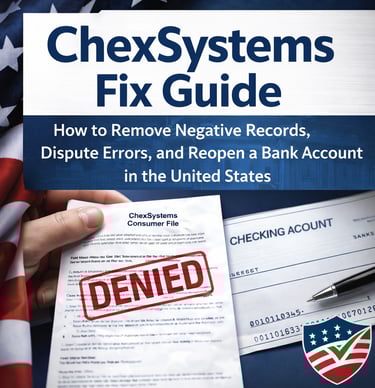
Our ChexSystems Fix Master Guide walks you step-by-step through:
Exactly how to read your report
What banks must legally verify
How to structure effective disputes
How to avoid common mistakes
How to position yourself for approval again
Every month you wait:
Is another month of potential business lost
Another month of financial delay
Another month of stress
Your name is your financial asset.
Protect it.
Fix it properly.
Move forward with clean banking power.
Every month you wait is costing you real money in fees, missed bonuses, and denied opportunities.
Stop guessing and stop getting rejected — fix it the right way.
👉 Get the ChexSystems Fix Master Guide now and take back control.
Help
Guidance for fixing your chexsystems report.
Contact
infoebookusa@aol.com
© 2026. All rights reserved.