
How to Remove Incorrect Personal Information from ChexSystems
Blog post description.
3/15/20265 min read
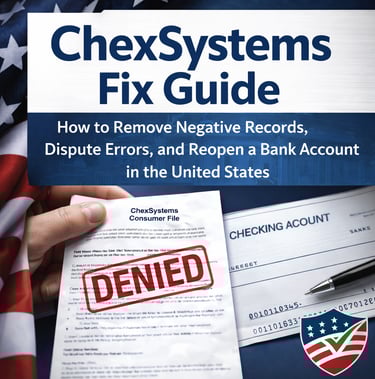
How to Remove Incorrect Personal Information from ChexSystems
A Complete, Practical, Step-by-Step Guide for U.S. Consumers Who Want Their Banking Access Back
If your bank account application was denied and you later discovered incorrect personal information inside your ChexSystems file, you are not alone.
Thousands of Americans every year lose access to basic banking services — not because of fraud, unpaid balances, or real risk — but because of:
Wrong Social Security digits
Incorrect addresses
Mixed files
Misspelled names
Accounts that belong to someone else
Outdated or duplicated personal identifiers
And here’s the dangerous part:
Even small personal information errors can trigger automatic denials across multiple banks.
This guide will walk you through exactly how to remove incorrect personal information from ChexSystems — legally, strategically, and efficiently.
No fluff. No vague advice. Just real-world steps that work.
What Is ChexSystems and Why Personal Information Errors Matter
ChexSystems is a nationwide consumer reporting agency that tracks banking history — not credit cards, not loans — but checking and savings account behavior.
Banks use ChexSystems when you apply for:
Checking accounts
Savings accounts
Joint accounts
Business accounts (sometimes)
Certain prepaid or second-chance accounts
When a bank pulls your ChexSystems file, they don’t just look at negative records.
They verify identity data.
If your personal information is incorrect, it can:
Cause an automatic fraud flag
Trigger identity mismatch
Link you to someone else’s record
Delay account approval
Lead to repeated denials
Incorrect personal information is not a small issue.
It’s often the root cause of banking exclusion.
What Counts as Incorrect Personal Information in ChexSystems?
Here are the most common types of errors:
1. Misspelled or Incorrect Name
Middle initial wrong
Suffix (Jr., Sr., III) missing or incorrect
Maiden name incorrectly listed
Completely wrong first name
2. Wrong Social Security Number (SSN)
Even one digit off can cause:
Mixed files
Fraud flags
Duplicate consumer profiles
3. Incorrect Date of Birth
4. Wrong or Outdated Addresses
Addresses where you never lived
Former addresses linked to fraud
Multiple mismatched states
5. Mixed File (Someone Else’s Data)
This is more common than people realize.
If another consumer has a similar name or SSN, your file can become merged.
This is called a “mixed file” error.
And it can destroy your ability to open accounts.
Step 1: Request Your ChexSystems Consumer Disclosure Report
Before disputing anything, you need the full file.
Under federal law, you are entitled to one free consumer report every 12 months.
You can request it directly from:
ChexSystems
You’ll need to provide:
Full legal name
SSN
Date of birth
Current address
Previous addresses
You can request it:
Online
By mail
By phone
Always download or request the full consumer disclosure, not a summary.
Review it line by line.
Step 2: Identify Every Personal Information Error
Do not focus only on negative banking entries.
Look at:
Header section
Identification information
Aliases
Previous addresses
Employment (if listed)
Mark every inconsistency.
Even small ones matter.
Why Fixing Personal Information Comes Before Removing Negative Records
This is strategic.
If your personal data is incorrect:
Disputes may get rejected
Responses may go to wrong address
Investigations may fail
Banks may still deny you
Correcting identity data first strengthens every future dispute.
It also reduces the chance of file reinsertion.
Step 3: Prepare a Proper Personal Information Dispute
This is where most people make mistakes.
Do not send vague letters like:
“Please remove incorrect information.”
You must:
Identify each incorrect item clearly
State why it is inaccurate
Provide supporting documentation
Demand deletion or correction
What Documentation Should You Include?
Depending on the error:
For Name Errors
Government ID copy
Social Security card copy
For SSN Errors
Social Security card
IRS letter showing full SSN
Bank statement showing masked SSN
For Address Errors
Utility bill
Lease agreement
Mortgage statement
Never send originals.
Send copies only.
Sample Dispute Structure (Personal Information)
Your letter should include:
Full name
SSN (last 4 digits only in letter body)
Date of birth
Current address
Clear list of disputed items
Formal demand for correction
Copy list of documents enclosed
Send it certified mail with return receipt.
This creates a paper trail.
Step 4: Understand the 30-Day Investigation Rule
Under the Fair Credit Reporting Act (FCRA), ChexSystems generally has 30 days to investigate disputes.
They must:
Verify accuracy
Correct inaccuracies
Delete unverifiable information
If they fail to verify the personal information, they must remove it.
What Happens During the Investigation?
ChexSystems may:
Contact reporting banks
Cross-check databases
Request additional documentation
Send results by mail
If corrected, you will receive an updated consumer disclosure.
Review it again.
What If ChexSystems Refuses to Correct the Error?
This happens.
In that case:
Request method of verification
File complaint with regulators
Send follow-up dispute
Consider escalating legally
You may file complaints with:
Consumer Financial Protection Bureau
Federal Trade Commission
These complaints often trigger faster internal review.
Mixed File: The Most Serious Identity Error
If your file includes:
Accounts not yours
Addresses in states you never lived
Different SSN variations
You may have a mixed file.
In these cases:
Send detailed affidavit
Provide identity verification documents
Demand immediate separation of files
Mixed file disputes require precision.
One vague sentence can delay everything.
Step 5: Verify the Correction Before Applying for a Bank Account
Do not rush to apply again.
First:
Request updated disclosure
Confirm incorrect data is gone
Confirm SSN and DOB are correct
Confirm no unauthorized aliases remain
Then apply strategically.
How Long Does It Take to Fix Personal Information?
Typical timeline:
7–10 days: Report arrives
30 days: Investigation
7 days: Response mailed
Total realistic timeframe: 30–45 days.
Rushing the process often leads to rejections.
Why Many DIY Disputes Fail
From real-world experience, common mistakes include:
Sending incomplete documentation
Failing to specify each incorrect item
Using online dispute portals (less documentation control)
Not sending certified mail
Ignoring follow-up
Banks rely heavily on automated screening.
If your file is still inconsistent, you will keep getting denied.
Strategic Tip: Separate Identity Correction from Debt Disputes
If you also have:
Unpaid balances
Fraud accounts
Account abuse records
Handle personal information first.
Clean identity data increases success rate of substantive disputes later.
When Identity Theft Is Involved
If errors stem from identity theft:
File police report
Submit identity theft affidavit
Freeze credit files
Dispute aggressively
Identity theft disputes are stronger when properly documented.
Advanced Strategy: Add a Consumer Statement (Temporary)
If investigation is ongoing, you may add a 100-word consumer statement explaining:
“Certain identification data is currently under investigation for accuracy.”
This doesn’t remove errors, but it provides context to banks reviewing manually.
After Correction: How to Rebuild Banking Access
Once personal information is corrected:
Apply at local credit unions first
Avoid applying at multiple banks simultaneously
Consider second-chance accounts
Bring ID documents in person
Strategic application reduces denial risk.
The Cost of Not Fixing Incorrect Personal Information
If you delay:
More denials
More hard inquiries
Delayed direct deposit access
Check cashing fees
Money order fees
Financial instability
Over one year, many consumers lose hundreds — sometimes thousands — in alternative banking costs.
All because of one wrong digit.
When to Get Structured Help
If you feel overwhelmed:
Mixed file
Multiple identity errors
Fraud accounts
Previous failed disputes
A structured step-by-step system can save months of trial and error.
Save Time. Protect Your Access.
Correcting incorrect personal information inside ChexSystems is not complicated.
But it must be done:
Precisely
Legally
Strategically
In the right order
If you guess, you delay.
If you delay, you lose time and money.
Want the Exact Templates, Affidavits, and Dispute Language That Works?
The ChexSystems Fix Guide shows you:
Exact dispute letter templates
Mixed file affidavit wording
Identity correction structure
Regulator complaint scripts
Escalation process
Bank re-application strategy
Timeline planning checklist
Instead of spending 60–90 days guessing…
You can follow a proven system and move forward confidently.
Every week you delay is another week without full banking access.
If your financial stability matters — fix it properly.
Every month you wait is costing you real money in fees, missed bonuses, and denied opportunities.
Stop guessing and stop getting rejected — fix it the right way.
👉 Get the ChexSystems Fix Master Guide now and take back control.
Help
Guidance for fixing your chexsystems report.
Contact
infoebookusa@aol.com
© 2026. All rights reserved.